Showing posts with label Joseph L. Mankiewicz. Show all posts

Tuesday, June 01, 2010

Double Wedding (1937)

Eagle-eyed Don McKeon, who has regularly contributed wonderful Scranton and Wilkes-Barre references to the movie blog, recently told me about a hilarious screwball romantic comedy from the mid-30s, starring Myrna Loy and William Powell (The Thin Man film series), that prominently features a sign reading "YOU ARE NOW LEAVING WILKES-BARRE. COME AGAIN" throughout the film. The film is 1937's Double Wedding and it was produced by Wilkes-Barre native Joseph L. Mankiewicz, who added references to Wilkes-Barre to almost every film he was a part of---from films he wrote/directed such as Oscar winners A Letter To Three Wives to All About Eve , to films he produced such as Reunion in France.

Double Wedding is the story of dress shop employee Margit (Myrna Loy), who is a major overbearing control freak over her sister Irene's (Florence Rice) life--even over Irene's fiance Waldo's (John Beal) life. When Irene, an aspiring actress, falls under the spell of eccentric film director and painter Charles Lodge (William Powell) and suddenly breaks off her engagement to Waldo, Margit is furious and will do everything in her power to make the wedding happen and distance her sister from the crazy director who lives in an auto trailer with a sign reading "YOU ARE NOW LEAVING WILKES-BARRE. COME AGAIN." pasted on the side.

The final 10 minutes of the film are some the funniest scenes I've ever seen in a movie.

Below are several screen shots taken from the film where the "YOU ARE NOW LEAVING WILKES-BARRE. COME AGAIN." sign is prominently displayed in the scene. There are several other scenes in the film where the sign is displayed but partially obscured. Click on any onf the images below for a closer view.

3:33 Irene (Florence Rice) and Waldo (John Beal) leave Charles Lodge's auto trailer after a rehearsal.
23:10 Margit (Myrna Loy) stares at the curious sign on Charles Lodge's auto trailer as she prepares to confront him about her sister.
31:21 Charles Lodge(William Powell) exits his auto trailer in the rain to answer a phone call at a neighboring business (he is alerted to all calls for him by a gong in his auto trailer).
37:14 Slowly warming up to each other, Margit (Myrna Loy) and Charles (William Powell) have a picnic in front of his auto trailer.
40:32 As Charles lay sleeping outside after the picnic, Margit (Myrna Loy) hops into his car and drives off with it and the attached auto trailer.
45:44 Margit (Myrna Loy) angrily storms into Charles's auto trailer after seeing him with her sister, after he promised to stay away from her.

Double Wedding is included on the DVD box set The Myrna Loy and William Powell Collection and is available to borrow from the Lackawanna County Library System. To place a hold, click here.

Much thanks again to Don McKeon for another great reference.

Monday, August 06, 2007

Reunion In France (1942)

UPDATED 8/29/07


Don McKeon from Scranton, who has submitted several wonderful local references in entertainment to this blog, emailed me on Saturday to tell me about a classic film in which not one, but two silver screen legends say Wilkes-Barre in their dialogue.

MGM's 1942 wartime melodrama Reunion in France stars Joan Crawford and John Wayne. It was produced by Wilkes-Barre native Joseph L. Mankiewicz, who added references to Wilkes-Barre to almost every film he was a part of---from A Letter To Three Wives to All About Eve.

Crawford portrays Michele de la Becque, a born-into-wealth Frenchwoman who could care less about the impending German invasion of Paris. After vacationing in the South of France, Michele returns home to discover Paris (and even her own home) has been occupied by the Nazis. Witnessing the Nazi occupation firsthand and upon discovering her fiance, a French manufacturer, has sold out to the Germans, Michele becomes a true French patriot and opponent of the Nazis.

One evening, Michele encounters downed American flyer Patrick Talbot (John Wayne) and decides to let him hide in her apartment as she attempts to get him safely out of the country.

In one scene, about 46 minutes into the film, Patrick and Michele are sitting in her apartment as an exhausted Patrick lays on Michele's bed:


Michele: When did you eat last?

Patrick: Eat? A couple of years ago in Wilkes-Barre. Leg of lamb, mashed potatoes, apple pie, three cups of coffee. Ever been to Wilkes-Barre?

Michele: Wilkes-Barre?

Patrick: Pennsylvania. Ever see the Susquehanna? Ever see Pittsburgh play Carnegie Tech? (gets up to leave) I'll get out in just a minute.

Michele: No, I think you better try to get some sleep.

Patrick: (dozing off) I don't need to try. Lady, here I go again.

After Patrick falls asleep, Michele examines his tag (which she finds hidden in the soul of his shoe) and reads it aloud: "RAF, Wilkes-Barre, Pennsylvania."


In the next scene, Michele and Patrick are having breakfast in her apartment:

Patrick: I told you all there is to tell.

Michele: Except for one detail. How did you get from Wilkes-Barre to the RAF?


A few scenes later, before they share their first kiss, Patrick says to Michele:


Patrick: Imagine what your eyes will do to Wilkes-Barre.


Later, when the Nazis are catching onto Patrick, a screen shot compares his U.S. military ID with his fake French student ID. The screen reads:


Name: Lieutenant Patrick Talbot
American Eagle Eagle Squadron, R.A.F.
Nationality: American
Address: Wilkes-Barre, Penn., USA


Patrick's final reference to Wilkes-Barre appears nears the poignant conclusion of the film:

Patrick: (to Michele) London isn't as far from Wilkes-Barre as...Lisbon.


In 1942, the public reaction to the then-topical Reunion in France was mostly negative--critics trashed the film and audiences ignored it.

Although I had Reunion in France on VHS a long time ago (and kept it in my collection for several years), I had never seen the film. Jim O'Neil, a colleague of mine who works in the Readers Service Department at Albright Memorial Library, asked me a few months ago if I had seen the film; when I told him no, he told me the film was atrocious and hysterically overdone and must be seen to be believed.

However, I borrowed the library's recently acquired DVD of Reunion in France and really liked it. I thought Crawford and Wayne both gave solid performances and had great onscreen chemistry.

Joan Crawford would make only one more film, 1943's Above Suspicion, before ending her longstanding MGM contract and signing with Warner Bros. Three years later, she won her first and only Oscar for 1945's Mildred Pierce; she continued starring in films (including Sudden Fear, Whatever Happened to Baby Jane? and Straight Jacket) and appearing on television until her death in 1977. However, after the publication of her adopted daughter Christina's scathing memoir Mommie Dearest in 1978, Joan's image became forever blemished with accusations of child abuse and, of course, with this memorable line.

John Wayne became a huge box office draw in Westerns such as Red River, The Searchers, and 1969's True Grit, for which he won an Oscar for Best Actor. He passed away from stomach cancer in 1979.

Reunion in France has recently been released on DVD, and a copy is now available to borrow from Albright Memorial Library. To place a hold on Reunion in France, click here.

Much thanks again to Don McKeon of Scranton. Keep em' comin'!

Wednesday, June 07, 2006

A Letter To Three Wives (1949)


My wonderful brother J.R. told me some time ago of a reference to the city of Wilkes-Barre in the 1949 Academy Award-winning film A Letter To Three Wives, written and directed by Joseph L. Mankiewicz.

Mankiewicz, who was born in Wilkes-Barre, also wrote the screenplay to All About Eve, which also included a reference to Wilkes-Barre in the dialogue (All About Eve was also the inaugural entry in this blog). Coincidentally, both A Letter To Three Wives (1949) and All About Eve (1950) won back-to-back Oscars for Best Screenplay (as well as Best Director) for Mankiewicz, the only such occurrence in the history of the Academy Awards. This distinction gives Wilkes-Barre, PA an ultra-rare (though unnoted until now) historic footnote in the history of cinema—city references included in two screenplays by the same author that won two consecutive Oscars.

Joseph L. Mankiewicz was born in Wilkes-Barre, PA on February 11, 1909. He began his career in film as a translator of intertitles for Paramount in Berlin. Upon returning to Hollywood, he worked as both a screenwriter and producer throughout the thirties and forties; he also produced several films starring Joan Crawford (including 1942's Reunion in France, which features several references to Wilkes-Barre). After directing his first film Backfire in 1946, Mankiewicz went on to direct such classics as The Ghost and Mrs. Muir, Now Way Out, Guys and Dolls, Cleopatra and, of course, All About Eve—which still holds the record of the most Academy Award nominations (14) in film history (tied with Titanic).

A Letter to Three Wives stars Jeanne Crain (State Fair, Cheaper By The Dozen), Linda Darnell (Mankiewicz’s No Way Out, Unfaithfully Yours) and Ann Sothern (Lady in the Lark, The Whales of August) as three friends in an affluent neighborhood. As they are boarding a ship to chaperone a school trip, a mailman delivers a letter addressed to the three of them from their friend (and town floozy) Addie Ross. Addie writes that she is leaving town for good and taking one of their husbands as a momento—neglecting to reveal exactly whose husband she stole. Though they display a brave front and a nonchalant attitude, each of the three women spends the day reminiscing about the ups and downs of her marriage -- wondering if hers is the husband who has flown the coop.

The Wilkes-Barre reference occurs during the flashback of “wife” Rita Phipps (played by Ann Sothern), a writer for radio shows. As she is having dinner with her possibly straying husband George (Kirk Douglas) and her radio show’s sponsors, a commercial for a breath mint begins playing during the radio show “Confessions of Brenda Brown.”

Announcer:

Euclid Street. Wilkes-Barre, Pennsylvania. What a thrill it was to hear my little girl say, “Mother, it’s much fun to have you read to us, now that you use Baby’s Breath.”

On the audio commentary on the DVD of A Letter To Three Wives (at 48:00), Joseph Mankiewicz's son Christopher explains that his father "never missed a chance in any screenplay that he wrote to pay homage to his city of birth and get it in the script."

A Letter to Three Wives is available for loan on DVD from the Lackawanna County Library System. To place a hold on the DVD, click here; to reserve the VHS, click here.

Much thanks again to my fantastic brother J.R. for this reference. Posted by Picasa

Friday, July 29, 2005

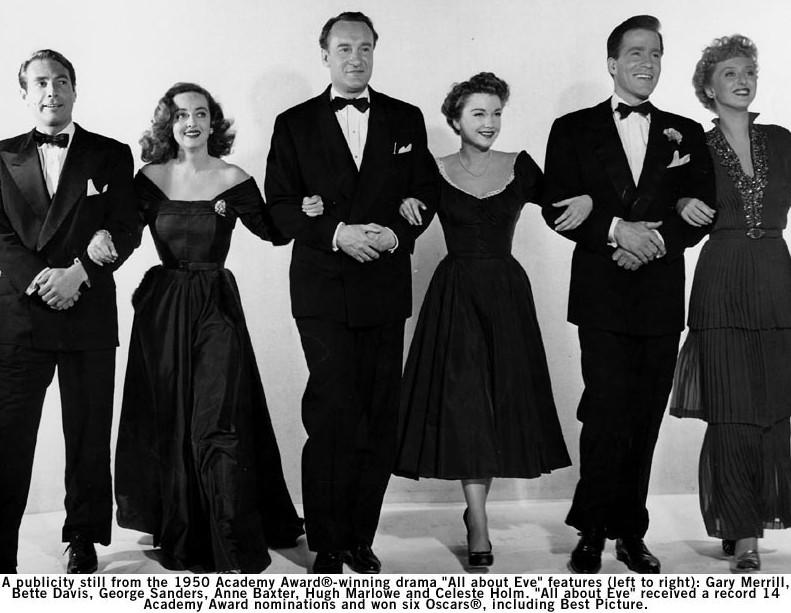
All About Eve (1950)


Ah, the classic 1950 Best Picture winner (tied with Titanic for the film with the most Academy Award nominations ever with 14).

The director, Joseph L. Mankiewicz, was born in Wilkes-Barre and has written and/or directed several classic movies, including Guys & Dolls, No Way Out, Cleopatra, and, of course, All About Eve.

Below is a section of dialogue, near the end of the film, in which Margo Channing (played by Bette Davis) mentions Wilkes-Barre:

MARGO

There goes Eve. Eve evil, Little Miss Evil. But the evil that men do - how does it go, groom? Something about the good they leave behind - I played it once in rep in Wilkes-Barre...

BILL

You've got it backwards. Even for Wilkes-Barre.

All About Eve, the film in VHS and DVD formats, and the original screenplay by Joseph L. Mankiewicz, is available to borrow from libraries throughout the Lackawanna County Library System. To place a hold on the DVD, click here; to reserve the VHS, click here. To reserve the original published screenplay by Wilkes-Barre native Joseph L. Mankiewicz, click here.